Launching a new medical school is not simply an academic exercise. Before the first student enrolls, an institution must demonstrate that it possesses the people, processes, systems, and infrastructure necessary to sustain the program for years to come. My role in the early development of the Sam Houston State University College of Osteopathic Medicine reinforced a lesson I’ve encountered repeatedly throughout my career: successful organizations build the architecture first and scale the operations second.
A Medical School Cannot Be Outsourced
Most people think about building a medical school in terms of faculty, facilities, and accreditation.
Those elements matter, but one of the earliest realities we encountered during the formation of the Sam Houston State University College of Osteopathic Medicine was that a new school cannot simply be assembled by hiring a group of experts and turning them loose.
Accreditation bodies expect institutions to demonstrate that they possess the internal capacity necessary to support the program. The university itself must be able to provide the operational, technical, administrative, and academic infrastructure required for long-term success.
That meant the early stages of the project relied heavily on existing university resources.
The founding leadership and faculty brought the expertise required to build a medical school, but they were far from alone. Existing faculty from across SHSU contributed specialized health and medical knowledge, including experts from the School of Nursing, School of Public Health, the Dietetics M.S. program, and the Southeast Texas Applied Forensic Science Facility (STAFS), better known as the “Body Farm”. At the same time, staff from instructional design, educational technology, academic administration, and student support helped establish the systems, processes, and infrastructure needed to support the college’s launch. Building the College of Osteopathic Medicine was not the work of a single department. It was a university-wide effort.
The challenge wasn’t simply creating a curriculum.
The challenge was creating an organization capable of delivering that curriculum.
Building Before There Are Students
During the pre-accreditation phase, the College of Osteopathic Medicine formation office was located directly above my team’s offices.
I spent a considerable amount of time going back and forth between floors.
As Digital Learning Advisor for the project, I worked alongside members of the founding leadership team, helping design the technological and instructional framework that would support the future curriculum. At that stage, there were no students and relatively few dedicated staff positions. Most of the work was being accomplished through a combination of newly hired leadership and existing university personnel contributing expertise from across the institution.
That arrangement was intentional.
The university needed to demonstrate that the new college wasn’t operating as an isolated entity. It needed to show that the institution itself possessed the resources and support structures necessary to sustain the program over time.
Building a medical school involves an enormous amount of planning that students never see. Curriculum structures, learning technologies, policies, support processes, reporting systems, accessibility considerations, and accreditation requirements all have to be established long before the first learner enters the classroom.
By the time students arrive, the architecture should already exist.
Growing from Shared Resources to Dedicated Resources
As the college matured, some responsibilities that had initially been supported through shared institutional resources gradually transitioned to dedicated staff within the medical school.
One example involved instructional design support.
When the college reached the point where a full-time position was justified, I served on the hiring committee responsible for selecting that individual. The candidate we ultimately hired was Christine, someone I had worked with years earlier at Windham before she moved to another large state agency.
Once she joined the College of Osteopathic Medicine, I helped onboard her into the instructional design and LMS environment, and worked with her to set up systems to deliver digital learning materials designed to scale and adapt. Over time, she became the college’s dedicated expert while maintaining strong connections to the broader support network that had helped launch the program.
In many ways, her role reflected the evolution of the college itself. What began as a project heavily supported by shared institutional expertise gradually developed its own internal capabilities while remaining connected to university-wide resources.
Even today, that partnership continues. When unusual LMS challenges arise, there is still a dotted-line relationship that allows – and encourages – collaboration and escalation as needed.
Successful organizations rarely become successful by operating in isolation.
They succeed because they know when to leverage shared expertise and when to build dedicated capacity.
The Invisible Work Behind Accreditation
One of the things I learned during the project is that the best educational infrastructure often goes unnoticed.
Students do not enroll because a reporting process was designed correctly. Faculty rarely celebrate a successful systems integration. Few people outside a project team appreciate the amount of planning required to align technology, curriculum, assessment, accessibility, and accreditation requirements.
Yet those foundational elements are often what determine whether a new academic program succeeds.
When a system is designed well, students focus on learning. Faculty focus on teaching. Administrators focus on outcomes.
The infrastructure becomes largely invisible.
That invisibility is often a sign that the work was done correctly.
What I Learned
The experience reinforced a lesson that applies far beyond medical education.
Organizations frequently focus on execution while underestimating the importance of architecture.
Everyone gets excited about launch day.
The harder work occurs beforehand.
Governance structures, staffing models, support systems, technology platforms, reporting processes, and operational workflows may not be the most visible parts of a project, but they are often the most important.
A strong foundation does not guarantee success.
However, a weak foundation almost guarantees problems later.
Final Thoughts
The launch of the Sam Houston State University College of Osteopathic Medicine remains one of the most rewarding projects of my career.
Not because of any single technology or process, but because it demonstrated what can happen when institutional expertise, executive leadership, and academic vision come together around a common goal.
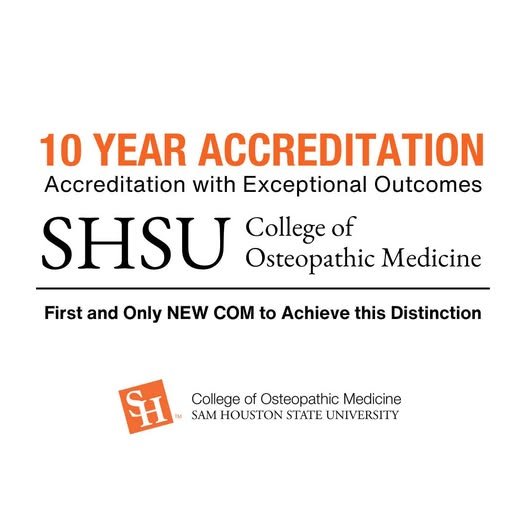
The college eventually became the first new medical school to receive its level of initial accreditation, an achievement made possible by an enormous number of people working behind the scenes.
I was honored to be counted among the “originals” who helped build it.
More importantly, the experience reinforced a lesson I’ve carried into every major initiative since:
Before you execute, build the architecture.
Everything else depends on it.
Further Reading / Project Artifacts
Being tagged as one of the “originals” alongside the leadership team that built the SHSU College of Osteopathic Medicine from the ground up remains a profound career highlight. You can view the reflections on the college’s historic initial accreditation and the team that made it happen here: