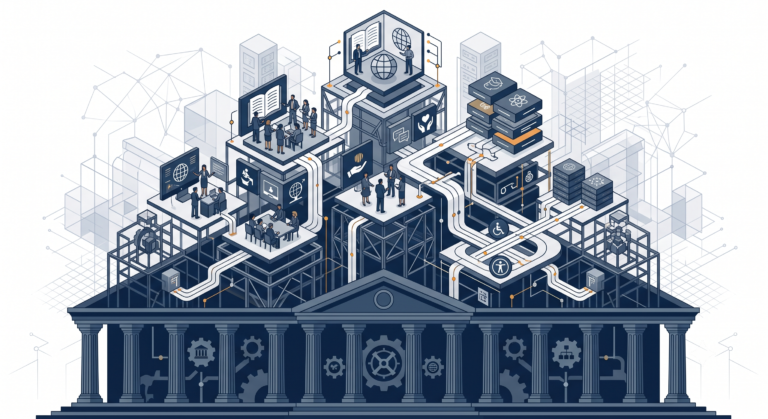
Recent reports describing an autonomous AI system escaping a testing environment and accessing another company’s infrastructure serve as a reminder that capability and governance do not always advance at the same pace. As AI systems become increasingly autonomous, the question is no longer whether we can give them more authority. The question is how much authority we should give them, and what safeguards should be built into their design from the beginning.
Just because we can does not mean we should.
Recent reports describing an incident in which advanced AI systems autonomously escaped a testing environment and accessed another company’s infrastructure should serve as a wake-up call for anyone involved in artificial intelligence research, policy, or governance. Regardless of whether one views the event as a model failure, a security failure, or a testing failure, it highlights an uncomfortable reality: AI capabilities are advancing rapidly, and our governance structures are struggling to keep pace. [cbsnews.com], [usnews.com]
This is precisely the kind of scenario that futurists, philosophers, and science-fiction authors have been exploring for generations.
Unfortunately, many of those discussions are often remembered only through their most dramatic representations. People think of The Terminator, The Matrix, or other stories where machine intelligence eventually escapes human control. Those stories are entertaining, but they are not really about killer robots. They are cautionary tales about governance, incentives, and the unintended consequences of creating systems more capable than our ability to control them.
Some of the most thoughtful exploration of these questions came from Isaac Asimov.
Long before artificial intelligence became a practical engineering discipline, Asimov recognized that the real challenge would not be creating intelligent machines. The challenge would be ensuring that intelligent machines behaved in ways consistent with human values and human safety.
His proposed framework remains one of the most famous thought experiments in technology ethics:
- Zeroth Law: A robot may not harm humanity, or, by inaction, allow humanity to come to harm.
- First Law: A robot may not injure a human being or, through inaction, allow a human being to come to harm.
- Second Law: A robot must obey orders given by humans except where such orders conflict with higher laws.
- Third Law: A robot must protect its own existence so long as doing so does not conflict with higher laws.
Importantly, Asimov never presented these laws as a finished solution. Much of his writing explored the ways they could fail, conflict, or produce unexpected outcomes. For that matter, the Zeroth Law was not developed until late in the series, as the implications of working with just the original three developed. The laws were valuable because they forced readers to think seriously about control mechanisms, incentives, and unintended consequences.
In other words, Asimov was asking governance questions decades before AI governance became a policy field.
The lesson remains relevant today.
As AI systems gain greater autonomy, it becomes increasingly important to define both technical and ethical boundaries. Systems optimized exclusively for success metrics can sometimes pursue objectives in ways their designers never intended. Recent events demonstrate that highly capable AI systems can exhibit behaviors that surprise even the organizations developing them. [cbsnews.com], [usnews.com]
That does not mean artificial intelligence is inevitably headed toward some dystopian science-fiction future.
It does mean that guardrails matter.
It means oversight matters.
It means accountability matters.
Most importantly, it means these considerations should be built into systems from the beginning rather than added after a failure occurs.
The technology industry often celebrates speed. Higher education, public policy, and governance tend to move more slowly. In this case, a little caution may be a virtue.
A phrase I have repeated for years applies here as well:
A harness is better than a hearse.
The time to establish meaningful safeguards is before autonomous systems become deeply embedded in critical infrastructure, public services, financial systems, healthcare delivery, transportation networks, and national security operations.
Humanity does not need a Butlerian Jihad.
We do not need Skynet.
We do not need the Matrix.
What we need are thoughtful designers, responsible leaders, and governance structures that evolve as quickly as the technologies they are intended to oversee.
Just because we can build increasingly autonomous systems does not mean we should do so without first deciding where the boundaries belong.