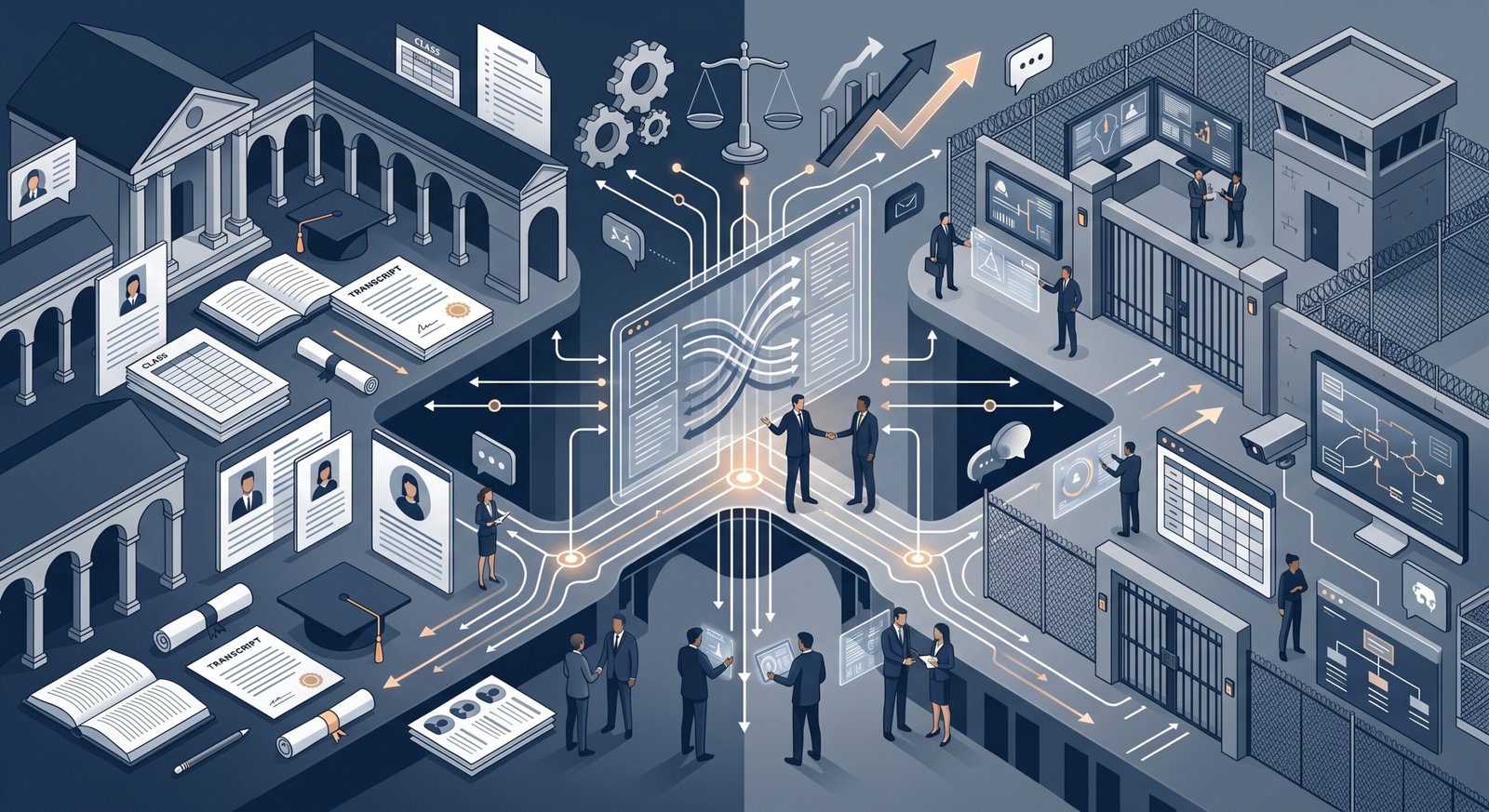
At first glance, the problem appeared to be college registration. In reality, it was a communication problem between organizations operating under entirely different assumptions. By creating standardized data exchanges between correctional education programs and Texas colleges, we eliminated layers of manual transcription, reduced reporting errors, and transformed a process that had consumed hours of staff time into one that could often be completed in minutes.
The Registrar and the Warden
Some of the most interesting technology projects are not really technology projects at all.
They are translation projects.
Years ago, while managing database operations and instructional effectiveness at the Windham School District, I was asked to help solve what appeared to be a registration problem involving college programs operating inside Texas correctional facilities.
At first glance, the issue seemed straightforward. College students were not always appearing correctly in the educational tracking systems used by prison school staff. Rosters occasionally required corrections. Staff spent significant time reconciling information between organizations.
The assumption was that data entry needed to be improved.
After digging into the process, it became clear that data entry was merely the symptom.
The real challenge was that three separate organizations were trying to manage the same students while speaking completely different operational languages.
Universities thought in terms of enrollment, credit hours, and academic terms.
Correctional facilities thought in terms of movement, accountability, and security.
Windham School District sat in the middle, responsible for educational reporting, state accountability requirements, and maintaining accurate records across a statewide educational system.
Everyone involved was working toward the same goal.
They just weren’t communicating through the same systems.
A Process Built for Islands
To understand the problem, it helps to understand the environment.
When I joined Windham in early 1996, the technical infrastructure looked very different than it does today. Most correctional education programs operated from local UNIX-based systems running at individual prison units. Some locations were still running SCO Xenix, while others had transitioned to SCO UNIX or early Red Hat Linux environments.
Updates were distributed through modem banks and overnight batch processing. Unit secretaries worked from central terminals while most other staff used VT-100 or Wyse “dumb” terminals connected through serial lines. Each facility maintained its own subset of data because local hardware limitations made centralized systems impractical.
Under that model, local data entry made sense.
If a college registrar sent information for an incarcerated student enrolling in classes, the unit secretary manually entered that information into the local educational database. The process was slow, but it fit the technical environment.
Over time, however, that environment changed.
Education technology grants allowed facilities across Texas to obtain internet connectivity. What initially began with technologies like ISDN eventually allowed Windham to centralize servers, move applications into shared infrastructure, and replace many local systems with Windows-based thin clients.
The technology evolved.
The process did not.
The Hidden Cost of Manual Entry
By the time I became involved with the project, approximately 21 partner colleges operated programs across roughly 35 correctional facilities throughout Texas.
Every semester, registration information moved through a complicated chain of people.
College registrars sent enrollment information to prison program staff.
Prison program staff relayed information – often with handwritten edits – to unit education personnel.
Unit secretaries manually entered student information into Windham’s tracking systems.
That data was necessary for more than educational records. Students needed to appear on movement rosters printed by the unit school so they could be checked out of housing areas, attend class, and be accounted for throughout the day. Accurate data mattered to both education and security operations.
The process worked.
It was also fragile.
Every layer introduced opportunities for delay, transcription errors, formatting inconsistencies, and missing information. It required hours of staff time and depended heavily on people retyping information that already existed somewhere else.
The more I examined the workflow, the more obvious one question became:
Why were we asking people to repeatedly enter data that already lived in a computer system?
Finding the Real Problem
Initially, I had been approached to improve how unit secretaries entered registration data.
What I discovered was that the secretaries were not actually the problem.
In fact, they were performing remarkably well under difficult circumstances.
The underlying issue was that colleges already maintained registration systems capable of producing the information we needed. Yet that information was being printed, emailed, faxed, interpreted, retyped, verified, corrected, and re-entered before finally appearing where it needed to be.
We weren’t suffering from a data-entry problem.
We were suffering from an information-flow problem.
That realization changed the entire direction of the project.
Getting Everyone to Speak the Same Language
Once we began contacting partner institutions, another challenge emerged.
Many colleges did not immediately realize their IT departments needed to be involved, even with direct instructions to do so. I had even prepared scripts for them to use to put in tickets / requests for IT assistance, which were ignored or went unused.
Some prison education programs operated somewhat independently from their institutions’ main registration systems. Others maintained local spreadsheets and processes that had evolved over time but had never been fully integrated into campus technology infrastructure and registration processing flow.
The result was predictable.
Some institutions sent files in wildly inconsistent formats.
Others attempted to manually create reports each semester and struggled to remember the process months later when registration opened again.
A few simply could not understand why we wanted structured data at all.
After enough conversations, I began working directly with provosts, deans, registrars, and IT directors .
Interestingly, several institutional leaders quickly grasped the value of the project once they saw the documentation.
More than once, I found myself on calls where administrators asked their own prison program staff why campus IT had not been included earlier.
The data already existed.
The problem was getting it delivered consistently.
A Five-Minute Solution to an Hours-Long Problem
Working with the colleges’ technical staff, we developed a standardized flat-file format for transmitting enrollment data.
Participating institutions generated files directly from their registration systems and submitted them electronically.
I validated the contents, dropped the file into the appropriate location, and ran the import process.
A task that had previously required hours of manual entry at individual facilities could often be completed in approximately five minutes.
More importantly, the process eliminated several layers of transcription and reconciliation.
Errors still occurred, but they became visible much earlier. If information was missing or inconsistent, the problem could usually be traced directly back to the originating system rather than being discovered only after multiple rounds of manual handling. Even better, because the reporting team cross-trained, it was set up so that the bulk of the initial registrations could be done even if both the unit secretary and I were both out for an extended time at a key point.
The result was not simply faster processing.
It was better and more reliable information.
The People Most Happy About the Change
The strongest supporters of the new system were not administrators.
They were unit secretaries.
For years, they had been caught in the middle.
When registration information arrived late, they were blamed.
When information was incomplete, they were blamed.
When students did not appear correctly on educational rosters, they were often the first people asked questions.
The new process did not eliminate their responsibilities. They still managed add-drop activity, handled exceptions, and reviewed error reports generated during imports.
What changed was that they were no longer responsible for manually transcribing information from one system into another.
A significant source of frustration simply disappeared.
Most prison education staff also embraced the changes quickly.
The few holdouts were typically programs that had been relying on highly informal processes. Once campus leadership became aware of some of those operational inconsistencies, staffing adjustments and process improvements often followed.
Over time, even the most reluctant participants came around.
An Unexpected Side Effect
One of the more interesting outcomes was that several colleges used the project as an opportunity to modernize their own practices.
In some cases, prison education programs had been maintaining records separately from their institution’s primary systems.
The new exchange process encouraged institutions to bring those operations into their central reporting environments, improving accountability, auditability, and consistency.
What began as a correctional education project ended up improving organizational practices well beyond correctional education.
That was never the goal.
But it was a welcome bonus.
What I Learned
This project reinforced a lesson I have encountered repeatedly throughout my career:
People often ask for help fixing a task when the real problem is the process surrounding the task.
Nobody came to me asking for a statewide data-exchange protocol.
They asked for help entering registration information.
The visible problem was manual data entry.
The actual problem was that information was moving through too many hands.
As soon as we focused on the movement of information rather than the mechanics of transcription, the solution became much clearer.
In many ways, this lesson mirrors projects I’ve discussed elsewhere on this blog.
Whether it is a historical transcription project, an LMS migration, or a correctional education workflow, the first problem presented is not always the most important one.
Quite often, the real work begins when you identify the problem behind the problem.
Final Thoughts
Looking back, the technology involved was relatively simple.
Flat files are not revolutionary.
Data imports are not revolutionary.
What mattered was getting organizations to agree on a shared process and a shared language.
Universities, correctional facilities, and educational administrators each viewed the world differently because their responsibilities were different.
The success of the project came from finding a way to connect those perspectives without forcing any of them to abandon what they did best.
In the end, the solution was not about registrars.
It was not about wardens.
It was about helping information move at the speed the students needed it to move.
And sometimes, that is enough to change an entire system.
#DataGovernance #SystemsIntegration #CorrectionsEducation #WorkforceEducation #HigherEducation #ProcessImprovement #Leadership #ChangeManagement #StakeholderManagement #OperationalEfficiency