Most conversations about educational technology focus on launching new systems. Much less attention is paid to retiring old ones. Early in my time at SHSU Online, our team inherited management of a correspondence-course division that appeared to be a relic from another era. What we eventually discovered was that the courses were not surviving because of institutional inertia. They were surviving because they solved a problem nobody had fully addressed yet.
Inheriting a Legacy
When our team assumed responsibility for the university’s correspondence-course operation, many people viewed it as an obvious modernization project.
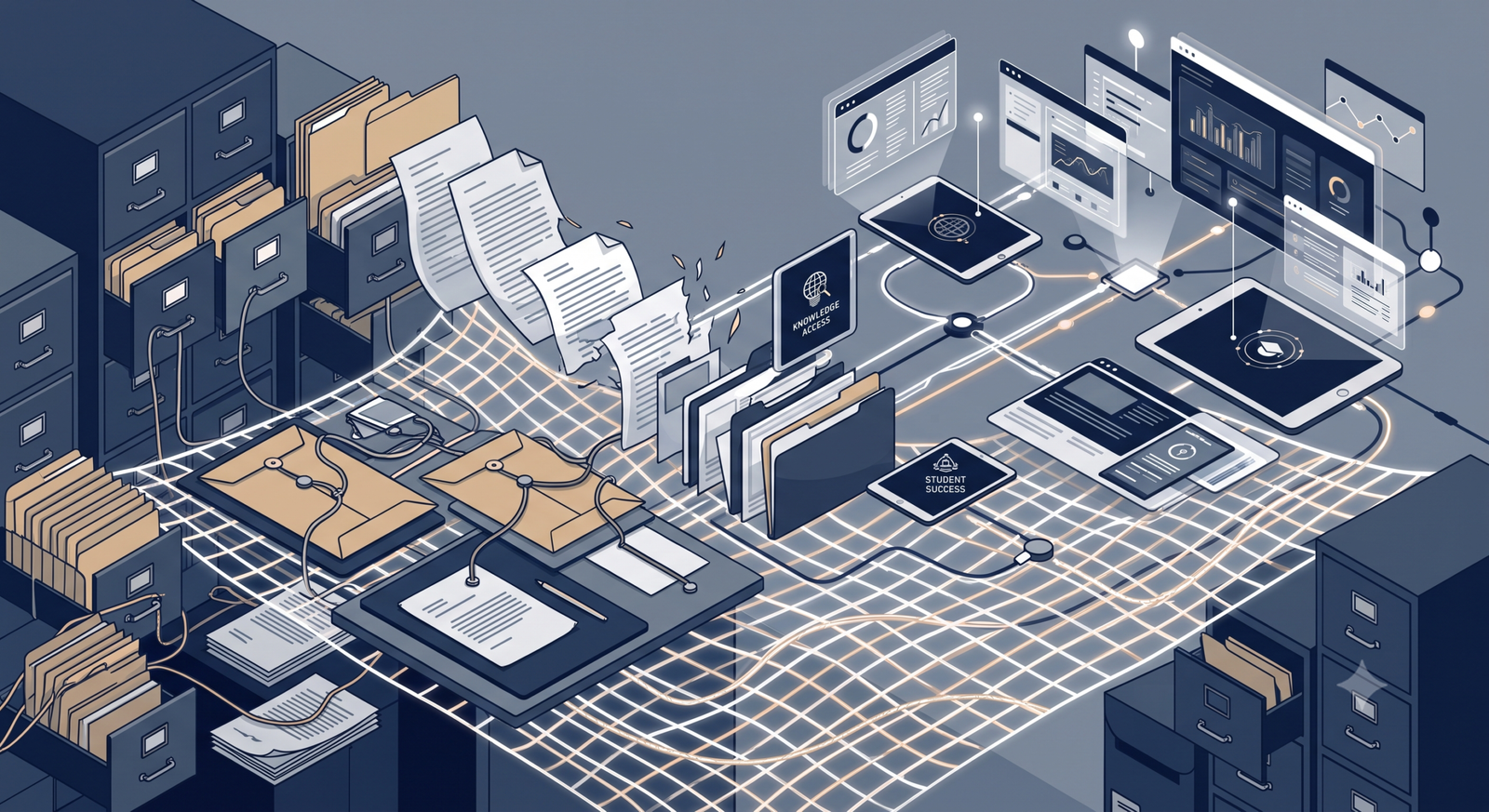
The model felt outdated. Students enrolled individually, worked at their own pace, and completed courses through a structure that predated modern online learning by dropping completed lessons into a physical drop-box at the Correspondence Office or mailing them in. Grades were mailed back. At first glance, the solution seemed obvious: move everything into a standard LMS environment and retire the old model.
That approach would certainly have been simpler.
It also would have been wrong.
One lesson I’ve learned repeatedly throughout my career is that long-lived systems usually survive for a reason. The technology may be outdated, but the need they address is often very real.
Before replacing a system, you first have to understand the problem it was designed to solve.
So instead of dismantling the operation immediately, we focused on stabilization.
The courses were brought into a modern online environment while preserving the same open-enrollment structure that students and departments were accustomed to using. We improved the delivery mechanism before attempting to redesign the service itself.
From Correspondence to Online Learning
Once the operation was stable, we began looking at ways to evolve it.
Most of the correspondence-course inventory was eventually redesigned and transitioned into more structured online offerings aligned with the university’s academic calendar. Course quality improved. Administration became easier. The student experience became more consistent, while still serving those who needed university education without having to move from where they lived.
It turned out that we only had only a small handful of students who had to have mail-based delivery system, and most of them were not successfully completing the courses before they expired, where shutting down that remnant option was the most responsible choice.
From an instructional-design and resource utilization perspective, online delivery was clearly a better model.
Over time, the vast majority of the correspondence inventory successfully moved into the mainstream academic environment.
But not all of it.
A small handful of courses remained in strong demand for accelerated and highly flexible formats.
At first glance, that seemed inconsistent with the broader strategy.
The reason didn’t become clear until we started examining who was actually using them – and why.
Discovering the Real Purpose
It turned out the correspondence division was not primarily serving students who preferred self-paced learning.
It was serving students who had run out of options.
Every semester, a small number of seniors would discover they were missing a required course needed for graduation. Sometimes it was an advising error. Sometimes it was a transfer-credit issue. Sometimes it was simply an oversight that nobody caught until the final degree audit.
Without a solution, those students faced an expensive and frustrating reality: delaying graduation for an entire semester because they were missing a single low-level course requirement.
The remaining open-entry courses functioned as an academic safety valve.
They allowed students to complete requirements on compressed timelines and stay on track for graduation.
What appeared to be a legacy instructional model was actually compensating for weaknesses elsewhere in the institution.
The correspondence program wasn’t solving a curriculum problem.
It was solving advising, scheduling, and planning problems.
The Safety Net Nobody Wanted to Need
Once that became clear, our strategy changed.
The objective was no longer simply to retire correspondence courses.
The objective was to understand why the safety net was needed and determine whether the underlying problem could be addressed directly.
For several years, those remaining courses continued serving their purpose. Students who might otherwise have delayed graduation were able to finish degree requirements and cross the stage with their classmates.
The courses weren’t ideal.
But neither was delaying graduation because of a single missing requirement.
Sometimes operationally imperfect solutions provide significant value.
The key is recognizing what problem they are actually solving.
When the Root Cause Was Fixed
Over time, institutional advising processes improved. Degree planning became more effective, advising practices became more consistent and increased asynchronous online offerings during the regular terms sidestepped student scheduling issues. As a result, he number of students reaching their final semester with unexpected degree deficiencies sharply declined.
At the same time, the university expanded its use of partial-term offerings. Late-term (final five-week) sections of courses that were frequently needed for graduation were scheduled routinely, creating a built-in mechanism to help students who discovered a missing requirement late in their academic careers. Policies were changed to more expediently grant exceptions for taking additional hours to work in an additional course in order to graduate.
As those improvements took hold, demand for the emergency correspondence options gradually decreased. The institution no longer needed a standing safety net capable of serving dozens of students each semester because the underlying causes were being addressed before they became crises.
Eventually, the need that had justified the remaining correspondence-style offerings largely disappeared. When the occasional issue did emerge, affecting perhaps only one or two students in a semester, the university could respond through a last-minute online independent study or special topics section offered during the final five-week sub-term. What had once required a dedicated operational system could now be handled through targeted academic intervention (and in a way that the most frequently impacted departments were motivated to mitigate the cause).
At that point, we were finally able to do what many people had wanted to do years earlier: retire the remaining open-entry model and fully integrate those courses into the standard academic catalog.
The difference was that we were no longer removing a solution without understanding its purpose.
The underlying problem had been addressed.
The safety net could finally come down.
What I Learned
This project reinforced a lesson that applies to far more than academic operations.
Organizations often rush to replace legacy systems because the technology appears outdated.
Sometimes that’s the right decision.
Sometimes those systems are quietly compensating for weaknesses elsewhere.
If you eliminate them without understanding why they exist, you may discover that the technology was never the real issue.
The visible system is often just a symptom.
The deeper operational problem is usually somewhere else.
Final Thoughts
The educational technology profession spends a great deal of time discussing innovation, implementation, and digital transformation.
Those activities matter.
But organizational maturity is not measured solely by what you build.
It is also measured by how thoughtfully you retire what came before.
The correspondence-course division taught me that every long-lived system has a story. Before replacing something, it is worth understanding the role it plays within the larger ecosystem.
In this case, a program that appeared outdated was quietly helping students reach graduation when other processes failed them.
Only after those underlying processes improved could the system be allowed to fade away.
That’s a lesson I’ve carried into every major technology and operational project since:
Never assume you understand the purpose of a legacy system until you’ve looked at who depends on it and why.