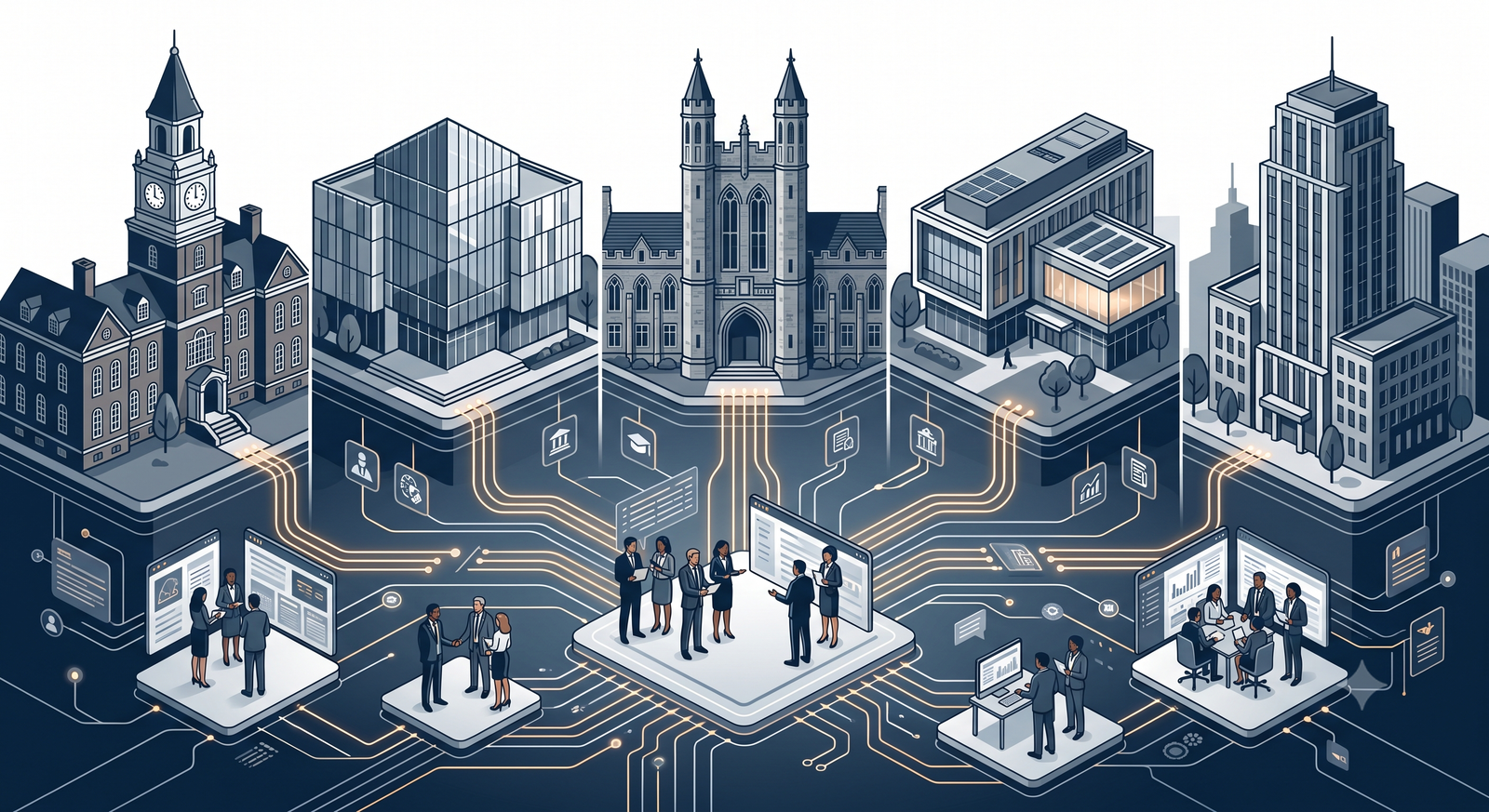
Most people assume an LMS migration is a technology project. My experience leading the Texas State University System Online Shared Services Initiative taught me otherwise. Consolidating five independent institutional learning environments into a shared ecosystem required far more work in governance, communication, and relationship-building than it did in technology. In the end, the greatest measure of success was how few people realized a major migration had occurred.
The Technology Is Usually the Easy Part
Whenever an institution announces a transition to a new Learning Management System, the immediate concerns tend to focus on the technology.
Will the courses migrate correctly? Will third-party tools continue to work? Will gradebooks calculate properly? Will students be able to find their assignments on the first day of class?
Those are important questions, but they all share one characteristic: they are ultimately solvable technical problems.
People problems are harder.
One of the largest projects of my career involved serving as Principal Product Owner for the Texas State University System Online Shared Services Initiative. The goal was to consolidate five independent LMS environments into a single, shared Blackboard ecosystem supporting more than 34,000 active students across multiple institutions.
The project was frequently described as an LMS migration.
Looking back, I think that description misses the real challenge.
The migration itself was the easy part. The difficult work involved governance, trust, communication, and finding ways for multiple institutions to share resources without feeling like they were surrendering control.
Five Institutions, Five Different Priorities
The institutions participating in the initiative each had their own cultures, processes, and histories. While everyone could see the potential benefits of a shared environment, there were understandable concerns about what would be lost in the process.
No campus wanted to feel like it was becoming a satellite of another institution.
That meant our challenge was not simply building a shared system. We had to build a shared system that still felt local to the people using it.
A faculty member at Sul Ross State University needed to feel like the platform belonged to Sul Ross. A student at Lamar State College Orange needed to feel like they were interacting with their institution. The same was true for Lamar Institute of Technology, Lamar State College Port Arthur, and every other participating campus.
The technology could be centralized. The experience could not.
Governance Before Technology
One of the earliest lessons from the project was that governance decisions had to precede technical decisions.
Before discussing migration schedules, system architecture, or integrations, we had to answer questions about ownership and authority.
- Who decides which tools are added to the platform?
- Who approves system-wide policy changes?
- How do you balance one institution’s priorities against another’s?
- How do you ensure every institution has a meaningful voice in future decisions?
Without answers to those questions, every technical discussion eventually becomes a political discussion.
Shared governance wasn’t merely administrative overhead. It was the foundation that allowed the technical work to proceed.
Once institutions were confident they would have a voice in the future of the platform, it became much easier to collaborate on the mechanics of building it.
Preserving Identity in a Shared Environment
One of the greatest risks in any shared-services model is over-centralization. It’s easy to focus on efficiencies and forget that institutions value their identity just as much as they value operational improvements.
Throughout the project, we worked to ensure that institutions retained a local presence within the shared environment. Students saw their own institutional branding. Support channels felt familiar. Communications remained tied to their campus rather than an unfamiliar external organization.
Behind the scenes, significant resources were being consolidated. From the user’s perspective, however, their institution remained their institution.
That distinction turned out to be critically important. Shared services become much easier to embrace when people feel like they’re gaining resources rather than losing ownership.
Success Looks Surprisingly Boring
Many technology projects are judged by launch day. I think that’s the wrong benchmark.
The real test is the first day of the semester.
Students should be thinking about their classes, not the LMS. Faculty should be focused on teaching, not troubleshooting access issues. If the platform dominates the conversation, something has probably gone wrong.
By that standard, the migration was remarkably successful.
Most students noticed they had access to additional tools, a newer LMS experience, improved online learning support, and dedicated 24/7 assistance. What most of them did not realize was that those improvements were the result of a major system-wide consolidation effort.
In fact, the only students who truly knew a migration had taken place were probably the handful who actually read the emails sent during the summer announcing the upcoming change and explaining the scheduled downtime.
As anyone who has worked in higher education knows, that is not a particularly large group.
The overwhelming majority simply logged in when classes started and got on with being students.
Honestly, that was exactly the outcome we wanted.
What I Learned
The project reinforced a lesson that has followed me throughout my career:
Technology projects are rarely about technology.
The software mattered, but software was never the limiting factor. The real work involved building trust among stakeholders, establishing governance structures, preserving institutional identity, and creating a framework that allowed multiple organizations to move forward together.
The accomplishment wasn’t moving courses from one server to another.
The accomplishment was creating a shared ecosystem that provided enterprise-level capabilities while allowing each institution to remain recognizably its own.
The first day of class arrived. Students logged in. Faculty taught their courses. Most people never gave the migration a second thought.
For a project of that scale, there is no better measure of success.
Further Reading / Project Artifacts
The TSUS Shared Services Initiative unified resources across the system to provide equitable digital learning environments. You can view the project scope, implementation timelines, and the SHSU Online leadership team directory on the Lamar State College Port Arthur institutional portal:






One Comment
Comments are closed.